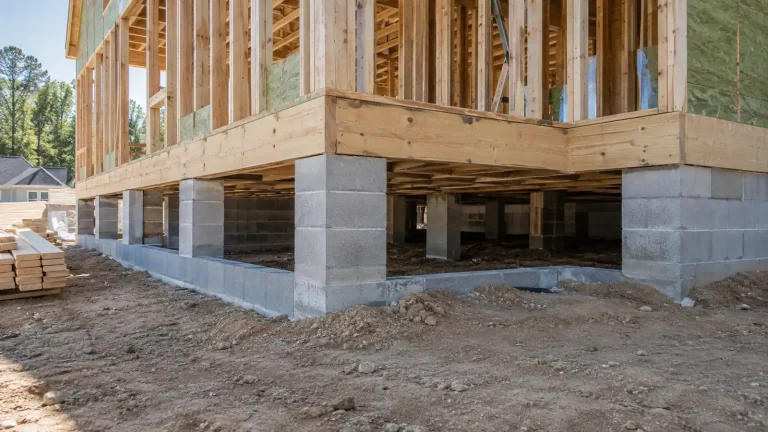
When a block wall comes across our desk, the owner usually has a number in mind based on the price of the blocks. That number is almost always low. The blocks are one of the cheaper parts of the job. The footing, steel, grout, labor and finish are what really set the price.
For 2026, a typical installed wall runs about $15 to $30 per square foot, and reinforced or load-bearing work can reach $20 to $40. Walls priced by length usually land between $60 and $240 per linear foot. That’s a fair starting range for almost any cinder block wall cost, as long as you know what sits inside it.
| Block wall cost item | 2026 planning range |
| Single block (materials only) | About $1–$5 |
| Installed wall, per sq ft | About $15–$30 |
| Installed wall, per linear ft | About $60–$240 |
| Labor only, per sq ft | About $10–$17 |
| Retaining wall, per sq ft | About $20–$35 |
| 25 ft long wall, installed | About $1,500–$6,000 |
Use these for budgeting, not bidding. When contractors send us drawings, our masonry estimating services price the wall from measured quantities, because averages miss the details that decide a masonry bid.
What Does a Cinder Block Wall Cost Per Square Foot?
We price most block walls by the square foot of wall face. National data splits that into roughly $5 to $13 for materials and $10 to $17 for labor, with footing, grout and rebar included.
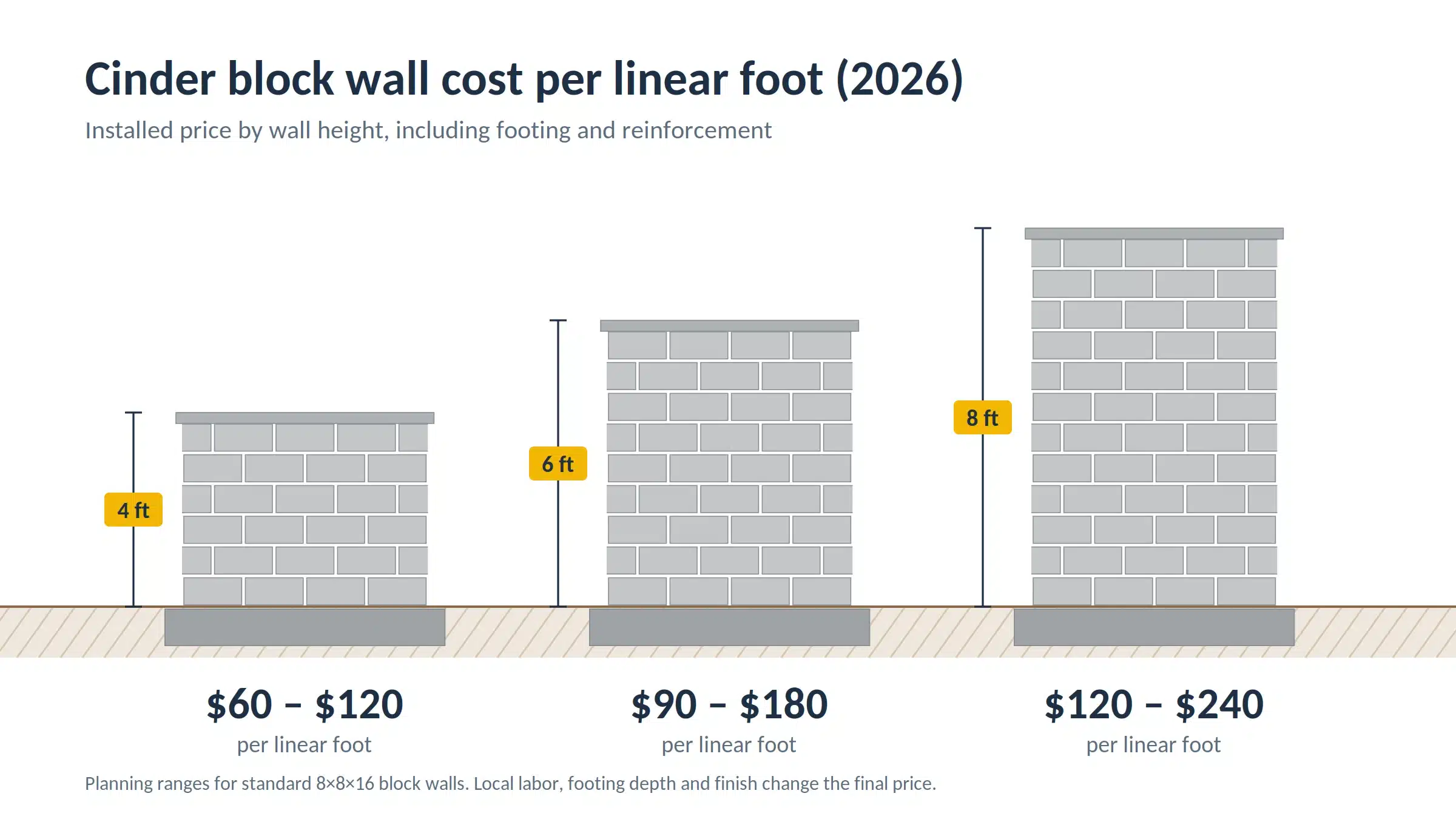
Freestanding walls are often quoted per linear foot instead. Height drives the price:
- 4 ft wall: about $60–$120 per linear foot
- 6 ft wall: about $90–$180 per linear foot
- 8 ft wall: about $120–$240 per linear foot
Most codes allow about 4 feet in a front yard and 6 to 8 feet in back.
You’ll also see numbers that don’t match. One source puts a 6-foot privacy wall at $75 to $120 per linear foot, below the ranges above. That’s usually scope, not error: one figure includes footing and finish, the other doesn’t. When we review competing bids, the first question is always what each cinder block wall cost actually covers.
Cinder Block Wall Cost by Wall Type
The job the wall has to do decides its engineering, and the engineering decides the price.
| Wall type | Installed cost per sq ft |
| Garden or privacy fence | About $15–$30 |
| Retaining wall | About $20–$35 |
| Garage walls | About $10–$35 |
| Shed walls | About $8–$16 |
| House walls | About $10–$40 |
| Foundation or basement walls | About $12–$18 |
These ranges include walls and footers. Runs under about 70 feet price higher per square foot, because the crew still has to mobilize and set up for a short wall.
Structural walls sit at the top because of bond beams, grouted cells, lintels and tighter rebar spacing. A complete two-car block garage typically costs $25,000 to $60,000, and our breakdown of the cost to build a 2 car garage shows where the walls fall in that budget.
Cinder Block Retaining Wall Cost: Why It Runs Higher
Retaining walls are where we see the most underpriced bids. A fence only has to stand up. A retaining wall has soil leaning on it permanently, and that load gets worse whenever the backfill is wet.
Expect $20 to $35 per square foot with gravel backfill and footing, and $35 to $65 for walls 3 to 6 feet high. The footing gets wider, most cells get grouted around vertical steel, and anything over about 4 feet generally needs drainage.
Past roughly 4 feet, most jurisdictions also want engineering, and a structural review usually costs $300 to $1,000. The line we see cut most often is drainage, which is also why so many retaining walls bow or crack within a few years. If a retaining wall bid doesn’t show drainage, question it first.
Where the Block Wall Budget Really Goes
We never carry a wall as one number. A cinder block wall cost only holds up when each scope is measured and priced separately.
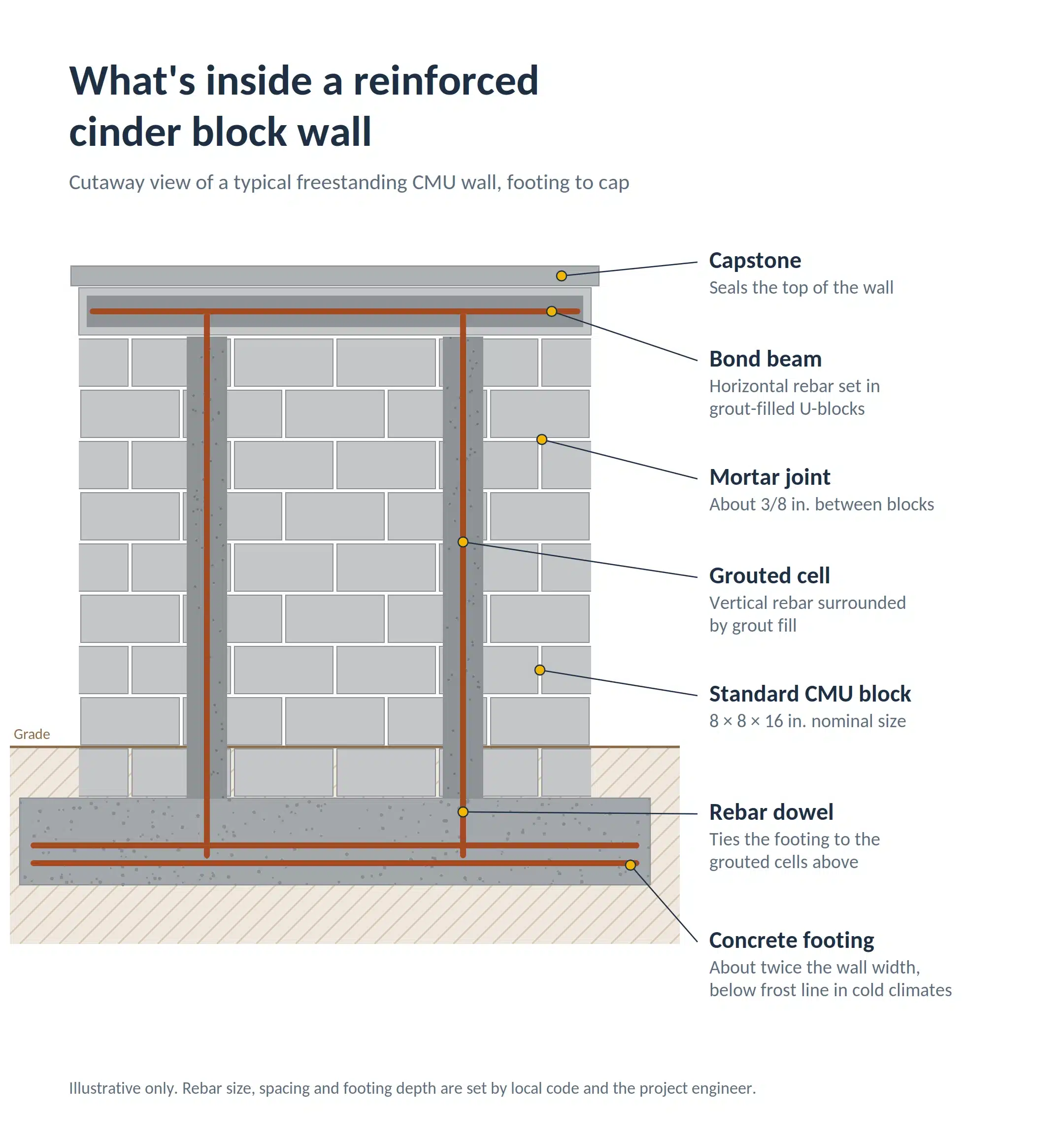
Cinder Block Wall Footing and Excavation
The footing is the first thing we take off and the part that decides whether the wall stays straight.
The standard starting point is a footing twice the block width, so an 8-inch wall sits on a 16-inch footing. For walls under 6 feet, expect at least 8 inches of thickness, two runs of #4 bar and vertical dowels every 32 to 48 inches, lined up with the cells you plan to grout.
Frost depth can change the whole scope. In northern states, footings may go 36 to 48 inches below grade. Excavation runs about $1 to $5 per square foot, and trenching $5 to $12 or more per linear foot in rock. Sloped lots need stepped footings, which add 15% to 30%.
Our concrete estimating service breaks out footing concrete, rebar and excavation separately, which is where many masonry bids hold or lose their margin.
CMU Block Price by Type and Width
The block line is usually smaller than owners expect:
- Standard 8×8×16: $1.25–$2.50 each
- Half blocks: $1.10–$2.00
- Split-face: $3.00–$5.00
- Solid blocks: $3.30–$5.00
- Bond beam units: $1.30–$3.00
- Caps: $1.00–$1.50
Width matters too. A 4-inch unit runs about $1 to $2, while a 12-inch unit runs $2 to $4. Half blocks at ends and openings, and caps along the top, are two of the most common misses we see on quick estimates.
Mortar, Grout and Rebar
Mortar is what the mason lays the block in. Grout is the flowable concrete poured into the cells around the rebar. The two get mixed up on bids all the time.
Type S mortar runs $8 to $15 per 80-pound bag, at about 7 bags per 100 blocks. A standard block takes roughly 0.25 cubic feet of grout to fill. Rebar and grout together typically add $1.00 to $5.25 or more per square foot, and whether the wall is solid-grouted or only grouted at reinforced cells makes a big difference. We always confirm that from the structural notes.
Labor and Crew Productivity
Labor is usually about half the job. Masons typically charge $5 to $10 per block, $10 to $17 per square foot, or $35 to $100 per hour.
We price labor from production. A good two-person crew lays roughly 75 to 125 blocks a day on straight work, and that drops fast with corners, cuts, pilasters and inspection stops. Region matters too: about $22 to $38 per square foot installed in the Northeast, compared with $13 to $24 in the Midwest.
Finishing: Paint, Stucco and Sealing
Bare block takes on water, so most walls need a finish. Masonry paint runs about $0.65 to $0.80 per square foot, stucco $3 to $4, sealant $2 to $10, and stone veneer $13 to $30. On a freestanding wall, price both faces. Carrying only one side is an easy miss.
What Pushes the Price Higher?
Overruns rarely come from one big surprise. They come from small items missing from the original cinder block wall cost:
- Permits: usually needed at 3–4 feet and up, typically $50–$450
- Demolition of an old wall: $5–$16 per linear foot
- Hillside or tight access: adds 20%–40%
- French drain behind the wall: $10–$35 per linear foot
- Curves, corners, pilasters and gate openings: extra cutting, lintels and labor
- Hurricane or seismic codes: tighter rebar spacing
- Peak season: spring and early summer quotes often run 5%–10% higher
Block Wall vs. Poured Concrete or Wood Fence
Block usually prices slightly below poured concrete, at $15 to $30 per square foot compared with $15 to $35. Block works better on tight sites with no forming. Poured concrete is stronger and easier to waterproof below grade.
Wood is cheaper upfront, at about $15 to $40 per linear foot compared with $60 to $240 for block. But block can last 50+ years, while wood typically needs replacing every 15 to 20. Over a few decades, the cinder block wall cost often comes out lower per year.
Repair and Long-Term Costs
Expect resealing every 5 to 10 years at $2 to $10 per square foot. Minor crack repairs usually run $100 to $500, and repointing costs $3 to $25 per square foot after 20 to 30 years.
When we look at a failing wall, the cause almost always goes back to the build: an undersized footing, no drainage, or cells that should have been grouted.
DIY or Hire a Mason?
A 120-square-foot wall costs roughly $360 to $720 in materials, compared with $1,800 to $3,600 installed, plus $100 to $300 for tools.
We’d keep DIY to garden walls under about 3 feet. Anything taller, retaining soil or tied to a building usually needs permits and inspections, and a failed inspection costs more than the labor saved.
A Realistic 6 Foot Cinder Block Wall Cost Example
Here’s how we’d rough out a 50-foot backyard privacy wall, 6 feet high: 300 square feet of wall face and roughly 355 blocks, based on 1.125 per square foot plus 5% waste.
- Block: $445–$890
- Caps: $40–$60
- Mortar (about 25 bags): $200–$375
- Grout and rebar: $300–$1,575
- Footing (about 2.7 cu yd at roughly $150/yd): around $400
- Trenching: $250–$600
- Labor ($10–$17 per sq ft): $3,000–$5,100
- Permit: $50–$450
That totals about $4,700 to $9,450 before finish, in line with national figures of $4,500 to $9,000 for this size. Paint on both faces adds a few hundred dollars, and stucco adds $1,800 to $2,400. A slope, frost-depth footing or split-face block will push this cinder block wall cost higher.
How Contractors Price a Block Wall From Plans
We start every block wall with the takeoff, not a unit price.
The site plan gives lengths, corners and openings. Wall sections give height, block width, footing size and bond beam locations. Structural notes give bar size, spacing and grout requirements. We count blocks by type, mortar, grout volume, rebar and footing concrete, then apply local production and pricing.
That’s how you get a cinder block wall cost you can actually bid. We use the same process on block basements and stem walls, covered in our guide to foundation cost per square foot.
What Should Be Included in the Estimate?
A bid we’d trust shows these as separate lines:
- Block and specialty units
- Mortar, grout and rebar
- Footing and excavation
- Labor
- Finish
- Permits and delivery
The exclusions we see most often are drainage, demolition, the engineer’s review, lintels at openings and finish on the back face. Delivery alone can add $50 to $200. A lower cinder block wall cost is often just a smaller scope, so compare the scope line by line before the totals.
Can You Cut Cost Without Cutting Quality?
Good places to save include standard gray block, straight runs instead of curves, full-pallet orders (which can cut material cost 10% to 15%) and off-season scheduling.
Places we’d never cut are footing size, reinforcement and grout, and retaining wall drainage. They’re buried once the wall is built, and they decide whether it stays plumb.
FAQs
How Many Cinder Blocks Are on a Pallet?
Usually 70 to 90, at about $115 to $225 per pallet. A full pallet weighs 2,500 to 3,250 pounds, and most suppliers charge a $15 to $20 refundable deposit.
How Many Cinder Blocks Do I Need for a Wall?
Multiply length by height, subtract openings, and divide by 0.9, since one block covers about 0.9 square feet with mortar. Add 5% to 10% for breakage and cuts.
How Tall Is a Cinder Block?
A standard block is nominally 8 inches high, 8 inches deep and 16 inches long. The actual size is about 3/8 inch smaller to allow for the mortar joint, so three courses make 2 feet.
What Is a CMU Wall?
CMU means concrete masonry unit, the trade term for cinder block. Modern blocks use cement, sand and gravel, so for pricing, cinder block and concrete block walls are the same.
How Heavy Are Cinder Blocks?
A standard 8×8×16 hollow block weighs about 28 to 36 pounds. Lightweight units are lighter, and solid blocks are considerably heavier.
Where Can I Buy Cinder Blocks?
Home improvement stores, building suppliers and landscaping companies carry them. For larger walls, a masonry supply yard usually offers better pallet pricing, delivery and specialty units.
Get the Block Wall Budget Right Before Construction
After years of reviewing masonry bids, the pattern is consistent: walls priced from a square-foot guess are the ones that go over budget. The real cinder block wall cost comes from the footing, reinforcement, block types, drainage, finish and local labor.
If your drawings are ready, send them over, and we’ll prepare a detailed masonry estimate from measured quantities before the first block is laid.