
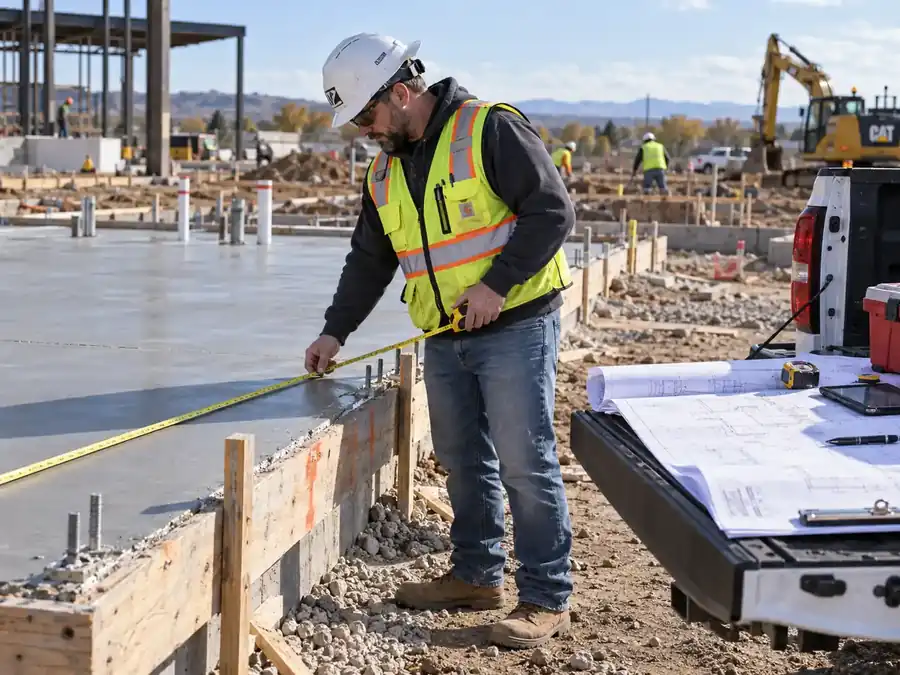
Every concrete order, haul-off count and fill import on a job comes down to one number: cubic yards. Get it wrong and you’re either paying for a short-load truck to finish the pour, or paying to haul away material you never needed. On our takeoffs, a bad yardage number is one of the most common reasons a site budget drifts.
The good news is that the math is simple once the units are right. To calculate cubic yards, multiply length × width × depth in feet, then divide by 27. Below, we walk through that formula for slabs, footings, walls, columns, trenches and fill, with the waste, swell and compaction adjustments estimators actually use.
The Basic Formula: How Many Cubic Feet in a Cubic Yard?
A cubic yard is a cube 3 feet long, 3 feet wide and 3 feet high. Multiply 3 × 3 × 3 and you get 27, which is the whole reason the formula divides by 27.
Cubic yards = (Length ft × Width ft × Depth ft) ÷ 27
The one rule that matters most: every dimension must be in feet before you multiply. Depth is where people slip, because slab thicknesses and fill depths are usually specified in inches. Divide inches by 12 first. Common depths convert like this:
- 2 in. = 0.17 ft
- 3 in. = 0.25 ft
- 4 in. = 0.33 ft
- 6 in. = 0.50 ft
- 8 in. = 0.67 ft
- 12 in. = 1.00 ft
If you measure in yards, you can skip the 27 and multiply yards directly. Most plans and field tapes read in feet and inches, though, so the ÷ 27 method is the one to learn.
How to Calculate Cubic Yards for Common Shapes
Not everything on a job is a rectangle. These are the formulas we use most often. Work every dimension in feet, find the volume in cubic feet, then divide by 27.
| Shape | Volume in cubic feet | Typical use |
| Rectangle | Length × Width × Depth | Slabs, pads, footings, walls |
| Cylinder | 3.1416 × radius² × Height | Piers, sonotubes, round columns |
| Triangle | (Base × Height ÷ 2) × Length | Sloped fill, haunches, berms |
| Trapezoid | ((Top width + Bottom width) ÷ 2) × Depth × Length | Sloped-side trenches, ditches |
| Ring | 3.1416 × (Outer radius² − Inner radius²) × Depth | Tank bases, round curbs |
| Average end area | ((Area 1 + Area 2) ÷ 2) × Distance | Irregular cuts and fills |
For odd layouts, like an L-shaped slab or a stepped footing, break the area into simple shapes, calculate each one, and add them together. That is exactly how a manual takeoff works, just on paper instead of in software.
How to Figure Out Concrete Cubic Yards
Concrete is ordered by the yard, so a small math error turns straight into money. Here’s how we figure out concrete cubic yards for the pieces that show up on almost every foundation plan.
Slabs: Converting Square Feet to Cubic Yards
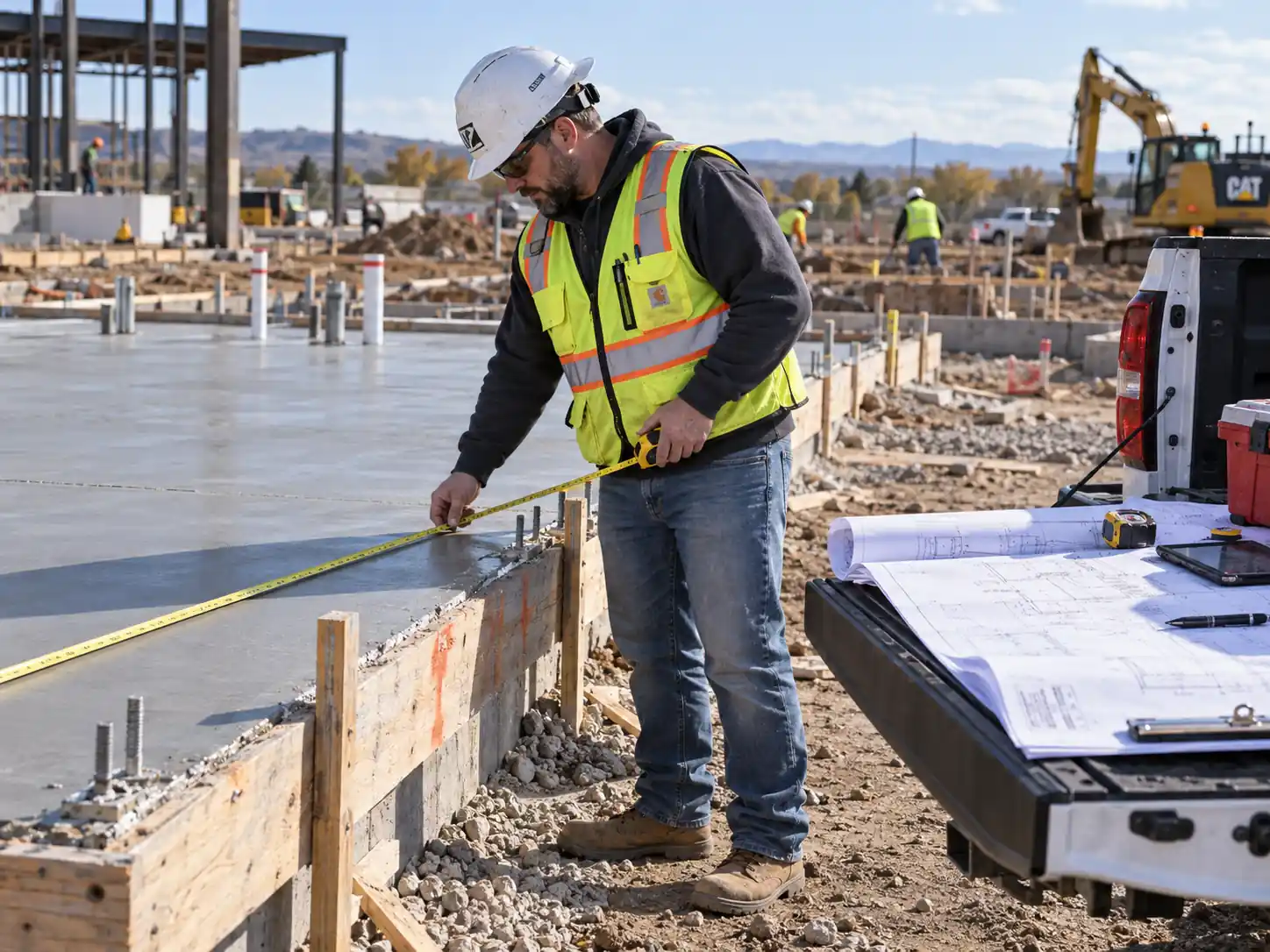
Slabs are the simplest case. Find the square footage, multiply by the thickness in feet, then divide by 27.
Take a 24 × 30 ft garage slab at 4 inches:
- Area: 24 × 30 = 720 sq ft
- Volume: 720 × 0.33 = 240 cu ft
- Yards: 240 ÷ 27 = 8.89 cubic yards
A quick field check is useful here: one yard of concrete covers about 81 sq ft at 4 inches or 54 sq ft at 6 inches. 720 ÷ 81 = 8.89, so the math holds. Watch for thickened edges and interior grade beams on the slab details. They’re easy to miss and can add a yard or more.
Footings and Grade Beams
Continuous footings are long rectangles, so take the cross-section area and multiply by the linear footage.
A 120 LF footing, 20 inches wide by 10 inches deep:
- Cross-section: 1.67 × 0.83 = 1.39 sq ft
- Volume: 1.39 × 120 = 166.7 cu ft
- Yards: 166.7 ÷ 27 = 6.17 cubic yards
Measure footing length along the centerline so corners aren’t counted twice. The same approach works for block wall footings, which our guide to cinder block wall cost covers from the budget side.
Foundation Walls
Walls are length × height × thickness, minus openings. A 40 ft foundation wall, 8 ft tall and 8 inches thick, with one 4 × 3 ft window:
- Gross volume: 40 × 8 × 0.67 = 213.3 cu ft
- Opening: 4 × 3 × 0.67 = 8.0 cu ft
- Net: 205.3 ÷ 27 = 7.60 cubic yards
Deduct openings larger than a few square feet. Small sleeves and blockouts usually get absorbed by the waste allowance.
Columns, Piers and Sonotubes
Round forms use the cylinder formula. A 12-inch sonotube has a 0.5 ft radius, so a 4 ft pier holds 3.1416 × 0.25 × 4 = 3.14 cu ft, or 0.12 cubic yards. Twenty of them come to about 2.33 yards. Pier counts add up quickly, which is why we always multiply by the full schedule rather than pricing one pier.
Waste, Rounding and Ordering Ready-Mix
The number from your formula is the neat volume. The order is always more. Plan for:
- Waste: add 5–10% for spillage, uneven subgrade and over-excavation. On-grade slabs and trenched footings tend to need the full 10%.
- Rounding: round small pours up to the nearest quarter yard, and larger orders to the next half or full yard.
- Truck size: a standard mixer holds 8 to 10 cubic yards, so a 24-yard pour is three trucks, not two and a half.
- Short loads: partial loads usually carry a fee of 40–60 per cubic yard, or 50–150 flat on small orders.
Using the garage slab above, 8.89 yards plus 10% is 9.78, so we’d order 10 yards and keep it to one full truck. Our concrete estimating service carries these allowances line by line for every slab, footing and wall on a set of plans.
How to Estimate Dirt Yardage for Excavation
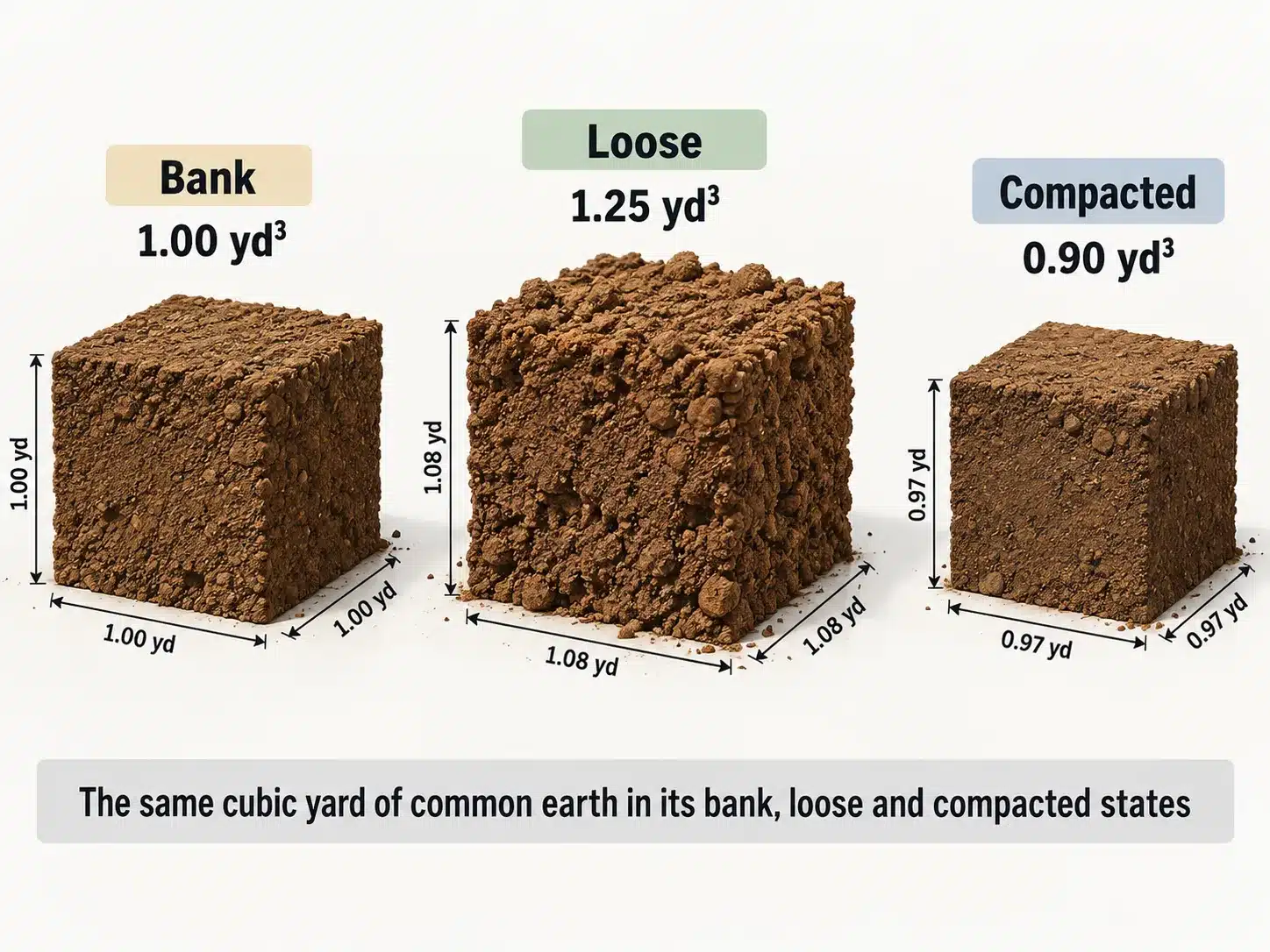
Dirt is where yardage gets tricky. The same soil takes up a different amount of space depending on whether it’s in the ground, in a truck, or compacted in place. To estimate dirt yardage correctly, you have to know which of those three states you’re measuring.
Bank, Loose and Compacted Yards
- Bank cubic yards (BCY): soil undisturbed in the ground. This is what you measure from the plans.
- Loose cubic yards (LCY): soil after it’s dug. It fluffs up, and this is what fills the trucks.
- Compacted cubic yards (CCY): soil placed and rolled as fill. It ends up denser than bank.
Always start from bank volume. Apply swell to get loose volume for hauling, and shrink to get compacted volume for fill. Applying a factor to the wrong state is one of the most common errors we see on earthwork bids.
Swell and Shrink Factors by Soil Type
| Soil type | Swell (bank → loose) | Shrink (bank → compacted) |
| Sand and gravel | 10–18% | 5–12% |
| Common earth (loam, sandy or silty clay) | 20–30% | 10–15% |
| Heavy clay | 30–40% | 15–25% |
| Ripable rock | 30–45% | Net gain; doesn’t shrink back |
| Blasted rock | 50–65% | Net gain; doesn’t shrink back |
These are planning values from standard earthwork references. On larger sites, the geotechnical report should override them.
Trench Excavation
A 200 ft utility trench, 2 ft wide and 4 ft deep with vertical sides:
- 200 × 2 × 4 = 1,600 cu ft ÷ 27 = 59.3 BCY
Now lay the sides back so the top is 6 ft wide. It’s a trapezoid:
- ((2 + 6) ÷ 2) × 4 × 200 = 3,200 cu ft ÷ 27 = 118.5 BCY
Sloping doubled the dig, which is why trench side slopes, benching and shoring always need to be confirmed before pricing. For hauling, apply swell. At 25% for common earth, 118.5 BCY becomes about 148 LCY, or 13 loads in a 12-yard truck. A 12 LCY truck only carries about 9.6 bank yards of that soil.
Irregular Sites: The Average End Area Method
Mass excavation and road cuts rarely have one clean depth. For those, estimators use the average end area method. Take cross-sections at set intervals, average each pair, and multiply by the distance between them.
If one section measures 120 sq ft and the next, 50 ft away, measures 80 sq ft:
- ((120 + 80) ÷ 2) × 50 = 5,000 cu ft ÷ 27 = 185.2 BCY
Repeat for every station and add the results. On large grading plans, this is done with 3D surface models instead of hand sections, which is where sitework estimating services come in for cut and fill balancing.
How to Calculate Cubic Yards of Fill and Backfill
Fill works in the opposite direction. The plans show the compacted volume you need, but the supplier delivers loose material that shrinks once it’s rolled. To calculate cubic yards of fill, find the compacted volume first, then divide by (1 − compaction %) to get the loose quantity to order.
Example: a 30 × 40 ft gravel base, 6 inches compacted:
- Compacted volume: 30 × 40 × 0.5 = 600 cu ft ÷ 27 = 22.2 CCY
- At about 15% compaction: 22.2 ÷ 0.85 = 26.1 loose yards
- Order: 26–27 cubic yards
Most fill jobs need 10–20% more material than the neat volume. For backfill, subtract the volume of the structure (the footing, wall or pipe) from the excavated volume, then apply the same compaction adjustment to the space that’s left.
Estimating Cubic Yards the Way Estimators Do
A formula gives you a number. A takeoff gives you a number you can bid on. When our team is estimating cubic yards on a project, the process looks like this:
- Measure from the plans, not the site. Slab edges, footing schedules and wall sections define the real quantities.
- Keep every state separate. Bank yards for excavation, loose yards for trucking, compacted yards for fill.
- Deduct what doesn’t get concrete or dirt, such as openings, embedded structures and pipe volume in backfill.
- Convert yards to loads. Dump trucks typically carry 10 to 16 cubic yards, and mixers 8 to 10.
- Sanity-check each line. Square footage ÷ 81 for a 4-inch slab, or length × cross-section for a trench, should land close to your detailed number.
That last check catches most transposed digits before they reach a bid.
Common Mistakes When You Calculate Cubic Yards
Most yardage errors aren’t math errors. They’re setup errors. The ones we catch most often:
- Entering inches as feet. A 4-inch slab typed as “4” instead of 0.33 comes out 12 times too large.
- Forgetting the waste allowance on concrete.
- Using bank yards to count trucks instead of loose yards.
- Ordering compacted volume for fill instead of loose volume.
- Missing thickened slab edges, grade beams and pier schedules.
- Measuring footing corners twice.
- Not rounding the concrete order up to a full quarter or half yard.
Build the habit of writing the unit next to every number. It’s the fastest way to calculate cubic yards without surprises.
FAQs
How Big Is a Cubic Yard?
A cubic yard is a 3 × 3 × 3 ft cube, about the size of a large washing machine. Spread flat, one yard covers roughly 162 sq ft at 2 inches, 81 sq ft at 4 inches and 54 sq ft at 6 inches, based on the 324 ÷ depth rule.
How Many Tons Are in a Cubic Yard?
It depends on the material. Concrete weighs about 2 tons per yard. Typical fill dirt runs about 1.2 tons, and sand and gravel about 1.4 to 1.6 tons depending on moisture and compaction. Always check the supplier’s ticket, since aggregate is often sold by the ton.
How Many Gallons Are in a Cubic Yard?
One cubic yard holds about 202 U.S. gallons (27 cu ft × 7.48 gallons per cubic foot). That conversion comes up with water, slurry and flowable fill.
How Much Is a Cubic Yard of Concrete?
Ready-mix generally runs $125 to $195 per cubic yard in 2026 before labor, with delivered residential orders often around $160 to $195. Short-load fees, distance and weekend delivery can push small orders higher.
How Much Is a Cubic Yard of Dirt?
Fill dirt usually costs $5 to $25 per cubic yard, and clean structural fill runs $15 to $30. Topsoil is higher, at about $12 to $55 per yard, before delivery.
How Many Cubic Inches Are in a Cubic Yard?
There are 46,656 cubic inches in a cubic yard (27 × 1,728). It’s a handy conversion for small volumes such as grout for anchor holes or core fill.
Get Your Quantities Right Before You Order
Accurate yardage is the difference between a clean pour and a short truck, and between a balanced site and an expensive haul-off. If you have plans ready, send them over for a detailed estimate and we’ll take off every slab, footing, trench and fill quantity for you.


